Psychology
Applied User Psychology · Research & essay · 2025
Applied User Psychology was a 12-week research module at Glasgow Caledonian University¹. I studied how psychology shapes the way people use digital products, one theory a week.
My role was UX research and design. Each assignment paired a theory with real products, and the module ended with an essay on Gestalt psychology in Airbnb.
Situation What was the problem or issue that I faced?
Products that ignore how people think feel disconnected, unintuitive or overwhelming, especially for a new generation that expects clarity and speed.
Task What did I have to do to fix this?
Understand the psychology behind user behaviour, and show how designers can apply it, across ten weekly assignments and a final essay.
Action What were the steps that I took?
Each week I took one theory, from persuasion and memory to Gestalt and emotional design, defined it, and analysed it in real products such as Airbnb, Spotify and Volvo.
Result What happened and what was the benefit?
A 33-page academic portfolio and an essay on Gestalt in Airbnb. It changed how I design: I now start from how people think, not only how a screen looks.
Ten topics, one a week
Every assignment followed the same rhythm: define the theory, find it in a real product, judge how well it works.
- 01 Defining psychology
- What applied user psychology is, and why designers need it
- 02 Persuasive design
- Persuasion, and who is responsible for digital wellbeing
- 03 Learning
- How people learn an interface, in an existing design
- 04 Memory
- Sensory, short-term and long-term memory in product design
- 05 Gestalt
- Proximity and continuity, including proximity in Spotify
- 06 Cyberpsychology
- AI as a creative tool, or a threat to creative work?
- 07 Synesthesia
- How colours and shapes cross the senses
- 08 Emotional design
- Designing for feeling, with Volvo as an example
- 09 Essay
- Gestalt psychology in Airbnb’s usability
- 10 Self reflection
- What changed in how I design
The essay
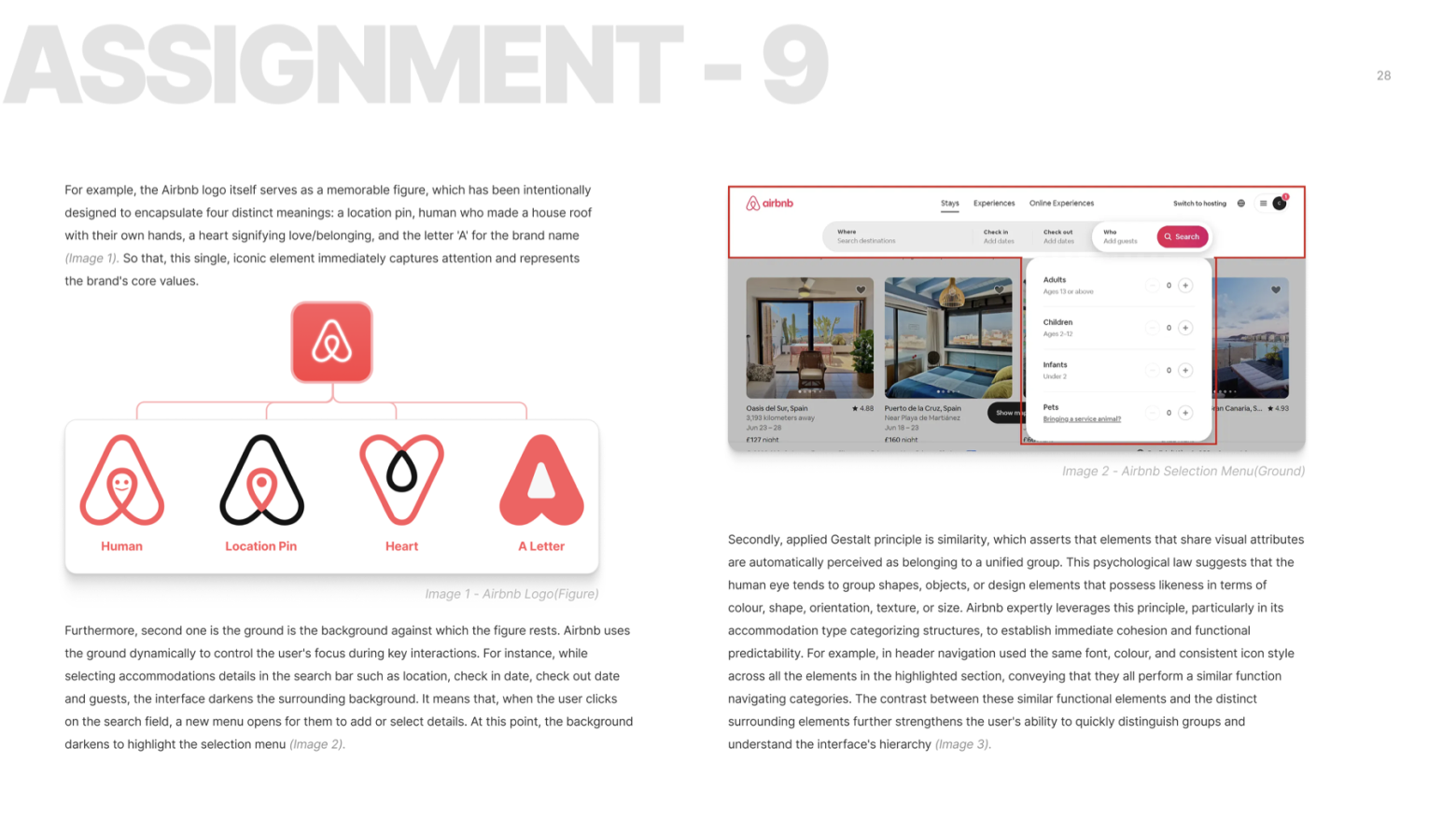
More than a listing: the role of Gestalt psychology in Airbnb’s usability. Airbnb changed how people search for and book places to stay. The essay looks at how three Gestalt principles make its interface feel easy.
- Figure-ground
- The logo is a memorable figure; the search field darkens the page behind it
- Similarity
- Category icons share one style, so they read as one set of choices
- Common region
- Dates, guests and Reserve sit in one bordered box, so they read as one decision
Reflection
- What surprised me
- How much of what people do in an app was planned by a designer, without them noticing
- What changed
- I used to think good design was mostly visual. Now I start from memory, Gestalt and emotion
- What I’d explore next
- How psychology shapes decisions about premium features and upgrades
Links
Case studyPDF1. University coursework (Applied User Psychology, Glasgow Caledonian University). Product examples are analysed, not my own work.


